


Does the movement of a chart really influence a trader's brain and decision-making?
- Passive Income Forex
- Feb 14
- 4 min read
Updated: Apr 5
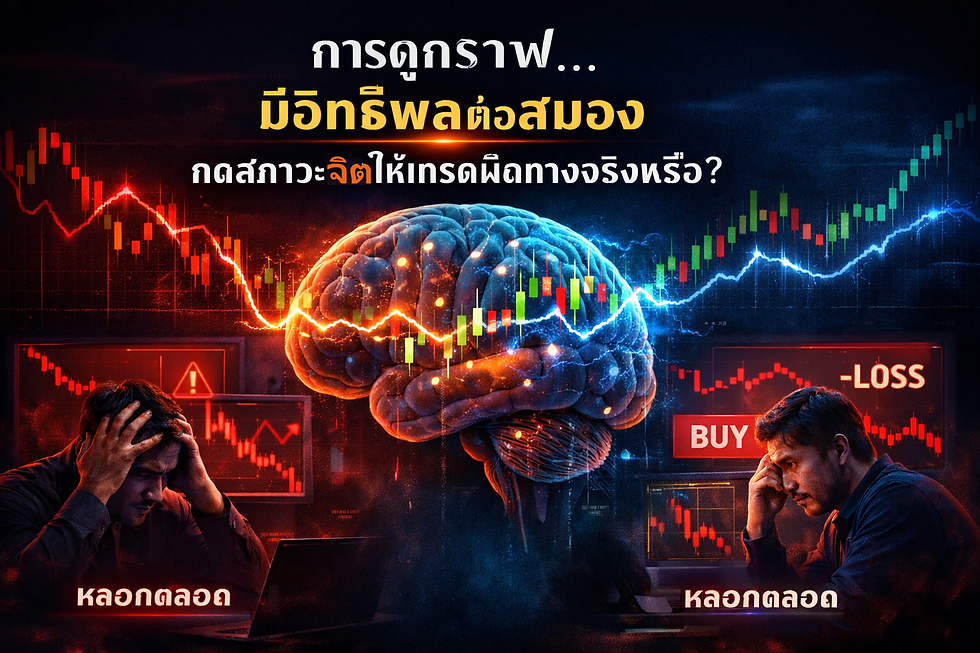
Yes, looking at price charts, the movement of chart lines, or "graph movements" really do influence traders' brains and decision-making. And there's research in psychology, behavioral economics, and neuroeconomics to support this idea. 👇
🧠 1. Our brains interpret graphs "automatically."

Humans have a remarkable ability to quickly extract patterns and meaning from images — this is what evolution has given us to assess risk and opportunity in real life. But in the world of trading…:
Price charts and chart patterns are processed by the brain as "signals" of important situations (e.g., risk/opportunity).
This process isn't solely based on logic; it also involves emotions, feelings, and expectations.
Neuroeconomics (a combination of psychology, neuroscience, and economics) suggests that emotions and memory play a role in risk-taking decisions, such as trading, by indicating that the body responds to “signals” and sends feedback to the brain’s decision-making center.
🎯 2. We often misinterpret graphs due to "brain biases".

Psychologists have found that we don't interpret data objectively.:
🧠 Confirmation Bias
We often only look for things that support our existing beliefs – so we might see patterns that aren't true on the graph.
🎯 Anchoring Bias
Previously seen prices, such as previous entry points or old support/resistance levels, will pull us towards our "destination," even if the actual situation has changed.
🔍 Pattern Recognition Error
Our brains tend to see patterns, even if "graph lines" are just random noise — that's why some people see "shoulder lines," "frames," or "trends" when in reality it's more noise than a signal.
😨 3. Emotions = determinants of decision-making.

Studies have shown that emotions (fear, greed) directly influence traders' decisions.:
Fear may cause people to rush to take profits or abandon positions.
Greed leads to exceeding the plan.
Frustration or indecision can lead to incorrect decisions that violate the core principles of a trading plan.
Numerous research articles and trading analyses indicate that emotional control is just as important as understanding charts, and is the key to becoming a successful trader.
🧠 4. What does neuroeconomics research tell us?

Neuroeconomics research studying financial decision-making using fMRI indicates that prices and market bubbles can alter value representation in the brain — simply put, the brain doesn't respond solely to information, but to "what it expects to happen."
In the field of neuroeconomics, which studies financial decision-making and brain responses, there are several internationally recognized researchers and institutions, particularly those using techniques like fMRI (functional Magnetic Resonance Imaging) to observe brain activity when making decisions about risk and reward, such as investing or making risky choices.

🧠 Examples of researchers and important institutions.
🔹 University of California, Berkeley – Haas School of Business
Research by Ming Hsu and his team studied brain responses via fMRI during decision-making tasks, analyzing how areas such as the prefrontal cortex play a role in learning about beliefs and predictions when faced with competitors or risky situations. The study was published in the Proceedings of the National Academy of Sciences (PNAS).
🔹 New York University – Center for Neural Science
Researchers like Paul Glimcher, considered one of the fathers of neuroeconomics, have published work in mainstream journals such as Nature and PNAS demonstrating the neural basis of value assessment and decision-making through the use of fMRI and various neurological studies.
🔹 University of Southern California (USC) – Neuroeconomics Lab
นักวิจัยอย่าง Giorgio Coricelli ทำงานด้าน neuroeconomics โดยเน้นการศึกษาพื้นฐานว่าความรู้สึก (เช่น ความเสียใจ หรือ regret) และการคิดเชิงกลยุทธ์ถูกประมวลผลอย่างไรในสมองระหว่างตัดสินใจ
🔹 Decision-Making and Neuroeconomics Group – UCL (University College London)
A research team at UCL studied how the brain “creates value” of different options and used neuroimaging to reduce the case-based definitions the brain makes when faced with multiple choices, while also examining the differences between reason and emotion in decision-making.
🔍 Examples of published research papers.
📄 Dissociable neural representations of reinforcement and belief prediction errors underlie strategic learning
PNAS (Proceedings of the National Academy of Sciences of the USA)
By Hsu, Zhu, Mathewson — fMRI is used to study how the brain responds to “prediction errors” in strategic decision-making (e.g., anticipating uncertain situations), which relates to how people make decisions under risk and competition.
🧠 Review research
Meta-analysis, such as that from MDPI, concludes from multiple studies that investment decisions involve several brain systems, such as the limbic system, which deals with reward versus risk. This supports the idea that financial decisions are not solely based on logic but also involve emotions and various neurological processes.
🧩 summarize
Neuroeconomics research focusing on financial decision-making and brain function:
✔️ Sourced from leading institutions such as UC Berkeley, NYU, USC, and UCL. ✔️ Utilizes rigorous scientific tools like fMRI/EEG to observe brain activity during decision-making. ✔️ Published in top academic journals such as PNAS, Nature, and Science. ✔️ Helps highlight that risk-reward decisions are a process that combines logic, emotion, and neural representation.

📌 Simple summary
The movement of a graph does affect the brain — but it doesn't magically "control" us directly 😅. It's a result of instinct, learning, memory, and brain biases that interpret the graph and make decisions based on emotions or expectations — which can lead to wrong decisions if not managed with discipline and system.

💡Tips for reducing the influence of graphs on your thinking.
✔️ Use a clear trading system and strict signal rules.
✔️ Practice recording your decisions. (Trading Journal)
✔️ Learn to recognize your own biases. (confirmation, anchoring etc.)
✔️ Implement risk management seriously.
XM offers a $30 no-deposit welcome bonus, trade with us and receive rebates, $15 per gold lot, and much more! Click now...!!! 😉✌️☯️


Comments